As the Arab spring becomes the 'American Fall', this article recalls the actions of the man who provided the spark for it all.
http://www.salon.com/2011/10/18/mohammed_bouazizi_ows/singleton/
Showing posts with label Libya. Show all posts
Showing posts with label Libya. Show all posts
Tuesday, October 18, 2011

Sunday, July 24, 2011
Counting the Cost of Conflict

Political upheaval and protest has had a huge knock on effect on the already fragile economies of some Arab states.
http://www.foreignpolicy.com/articles/2011/07/22/the_arab_recession
Tuesday, June 7, 2011
To Dictate or Not to Dictate?

A further look at the role of the ICC in the prosecuting of the 'war' on Gaddafi, with the view that the body has done more harm than good in the matter.
http://www.washingtonpost.com/opinions/after-the-dictators-fall-/2011/06/02/AG57AmJH_story.html?hpid=z3
http://bosco.foreignpolicy.com/posts/2011/06/06/the_case_for_impunity
Sunday, May 29, 2011
European Union?
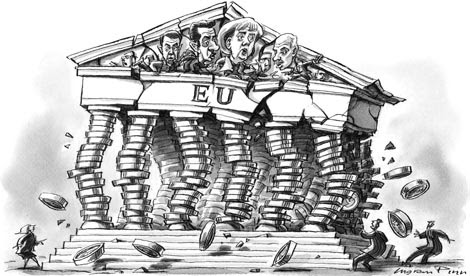
The lack of harmonisation with regards to Europe's collective policy on Libya is clear and prehaps evidence of a bigger problem; the failure to create a clear vision of the role of the European Union in the wider world.
http://www.truthdig.com/report/item/libyan_intervention_exposes_european_disunity_20110524/
The ICC and Validating War
The role of the ICC in providing justification for military intervention
http://www.prisonplanet.com/the-fake-icc-the-globalist-strategy-of-tension.html
http://www.prisonplanet.com/the-fake-icc-the-globalist-strategy-of-tension.html
Sunday, May 15, 2011
The Arab Spring and Western Colonialism

Video of a talk given by Noam Chomsky at a FAIR anniversary celebration
http://readersupportednews.org/off-site-opinion-section/133-133/5928-arab-springs-threat-to-western-colonialism
Friday, May 13, 2011
All Fall Down: But What Rises Up?
 |
| Arab Leaders Under Threat |
The danger of letting democracy loose in the Middle East, according to the Atlantic
http://www.theatlantic.com/magazine/archive/1969/12/danger-falling-tyrants/8493/
Sunday, April 3, 2011
Europe Sharing the West's Burden?
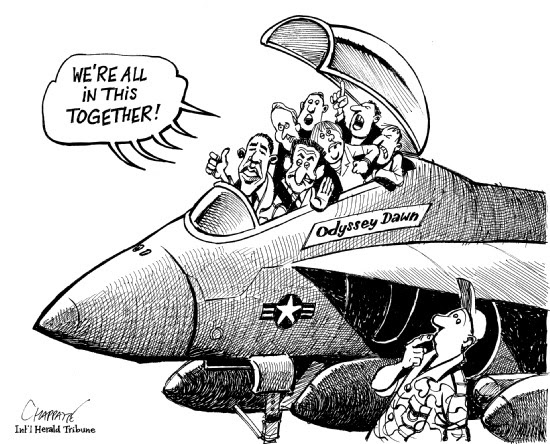 |
| The end of American Unilateralism? |
Recent French and British leadership with regards to the crisis in Libya and the pro-active French stance on the growing civil war in one of it's former colonys, the Ivory Coast, may reveal a turning point in European interventionist policy and reassertion of Europe's role within the world.
The history of European intervention outside of its geographical borders is relatively long and quite well known but European leadership on international affairs subsided post World War II and practically ceased to exist as the Cold War escalated throughout the 1950s and 1960s. At this juncture the burden fell to the USA to export and protect western liberal democracy and the capitalist system, a role it seemed to relish under successive administrations. Under the previous administration however, the policy of unilateral intervention, particularly military intervention, reached an impasse. The American voters woke up to both the financial and actual cost of their governments adventures, with trust in the American way of doing things viewed with suspicion among allies and enemies and a general anger in Europe at America's perceived cultural ignorance, lack of forward thinking and unilateral dismissal of the UN whenever it suited them.
The current American administration seem to have taken some lessons of the Bush years on board and applied them to it's own foreign policy. In effect what President Obama is doing is allowing limited American intervention in areas that may affect American interests, but stressing the limited nature of the mission and the fact that America will not lead. By doing this Obama is pleasing those who claim that America cannot afford another war, he is keeping the military action 'low-key' so as not to stir up further resentment in the Muslim world for the US and he is ceding a large degree of control and responsibility to the office of the Secretary of State, Hillary Clinton.
So the pressure fell to a European Union, some of whose member states recent actions in promotion of democracy in the Mediterranean can claim a degree of blame or responsibility for the recent instability along the Sea's southern coastline. With Germany's Chancellor facing a difficult election this year she chose to dither and offer conflicting reasons, Italy cited the refugees they would inevitably be inundated with, France, not for the first time in European history, led the charge, followed swiftly by the UK. Taking this initiative and stressing that this would be a NATO led mission with primary strikes led by Europeans Sarkozy has opened a new chapter in the relationship between Europe and the world, especially it's African neighbours. Is Europe willing to provide another counter balance to China's growing assertion of its sphere's of influence? Is Europe willing to usurp the tainted presence of the American mission in the middle east, particularly with regards to Iran, and try create lasting stability in the region? Or is this merely a muscle flexing exercise by Sarkozy and Cameron, something to appease the voters at home and keep the oil pumping?
Saturday, March 26, 2011
Latest Reactions On Libya
 |
| http://www.spiegel.de/fotostrecke/fotostrecke-66041-12.html |
German suspicion over motives for attack
http://www.spiegel.de/international/germany/0,1518,753126,00.html
Bill O'Reilly's take on American Intervention
http://townhall.com/columnists/billoreilly/2011/03/26/the_triumph_of_evil
Recent Political Patterns may point to a devestating finale
http://www.independent.co.uk/opinion/commentators/adrian-hamilton/adrian-hamilton-the-end-of-the-world-as-we-know-it-2249983.html#
Sunday, March 20, 2011
As the Bombs Drop, the Debates begin Anew

"Force is all-conquering, but its victories are short-lived." - Abraham Lincoln
http://www.un.org/apps/news/story.asp?NewsID=37823&Cr=Libya&Cr1
Should there be military intervention in Libya?
http://www.foreignpolicy.com/articles/2011/03/18/does_the_world_belong_in_libyas_war
Sunday, March 13, 2011
No Fly Zone a No Go Zone?
 |
| Protesters Call for a No Fly Zone |
As the situation in Libya begins to take on the look of a bitter civil war than an uprising against a despot the leaders of the global community disagree sharply on what action to take. The phrase 'No Fly Zone' has been banded about as if it were an easy imposition rather than a declaration of military intervention in a still sovereign state. Is there a will to intervene in Libya? If so from who? Which actors could conceivably put boots on the ground and who would it serve?
The most obvious answer to the first question is no, there is no great desire among any of the states capable of intervening, to intervene. France and the UK seem to talk a good fight, but with British troops unpopularly involved in Afghanistan and both countries still viewed as neo-colonialists by many in North Africa, their involvement against Gaddafi's forces would only fuel his rhetoric against the West and reinforce his view that he is the defender of Africa, the defender of Islam. The USA is in a difficult position as well, with American public opinion seemingly against further military intervention in the Middle East, and Obama unwilling, it seems to have his forces bogged down in an unwinnable war, just as Clinton's were in Somalia.
The will to intervene is coming almost solely from the Libyan opposition and the Arab League, who have just passed a resolution supporting the imposition of a No Fly Zone by the UN, recognising the Libyan opposition, the National Libyan Council, as the legitimate government. But who will it serve and who will impose the restrictions. Clearly the big question is oil,since the beginning of the current crisis oil prices in Europe have risen immensely and this may drive intervention, if only to restore stability and keep the oil flowing. This is not essentially a humanitarian issue for the Western powers, if Gaddafi offers the best chance of stability they will support him, providing it won't negatively affect their own moral legitimacy. The Arab League is eager to see foreign intervention in Libya, believing if they sacrifice Gaddafi and involve non-Muslim, non-Arab military forces it will quieten the protests simmering in their own countries. the only organisation which could put boots on the ground is NATO, but they must chose a side first, and one suspects they are waiting to see how successful Gaddafi's current counter attack is, waiting to see how strong his actual support base is, before they back a side.
Friday, March 11, 2011
Monday, March 7, 2011
Role of the Modern Media
 |
| In the Thick of It |
The Importance of Primary Source Reporting in Modern Warzones
http://www.counterpunch.org/amin03042011.html
Saturday, March 5, 2011
The Economic Roots of the Recent Rumbles
 |
| Blair with Gaddafi |
"Democracy don't rule the world, You'd better get that in your head; This world is ruled by violence, But I guess that's better left unsaid"
Bob Dylan : American folksinger, b.1941
Digging deeper than the Domino: A look at the economic realities in the Middle East
Libya on the Brink: Should I Stay or Should I Go Now?
 |
| Some reasons military intervention in Libya is rapidly becoming an option for the US and Europe |
It seems like non-intervention is not an option for the CIA in Libya
http://voices.washingtonpost.com/spy-talk/2011/03/libya_what_should_cia_be_doing.html
Friday, March 4, 2011
The Arab Spring

The seeds sown during these past few weeks will bloom in the coming years.
http://www.thenation.com/article/158991/arab-spring
Monday, February 21, 2011
Mad, Bad and Dangerous to Live Under
http://www.bbc.co.uk/news/world-middle-east-12520586
The Gaddafi family point an accusatory fingure at everyone but themselves, insisting that Civil War is a more realistic option than political concessions.
The Gaddafi family point an accusatory fingure at everyone but themselves, insisting that Civil War is a more realistic option than political concessions.
Sunday, February 20, 2011
Libya: This Colonel is Not for Turning
Recent anti-government protests in the Libyan city of Benghazi, and the subsequent reaction by the armed forces, have caught the attention of the world’s media in the last few days, quick on the heels as they were of the ‘victory’ of the Tahir Square ‘revolution’ and the fall of Ben Ali’s government in Tunisia. The wave of popular demonstration has been over simplified by painting the whole region as geopolitically the same; essentially undemocratic, ruled by a despotic elite and tethered together like a string of dominos. From this logic follows the obvious conclusion that Gaddafi will eventually be forced to listen to the grievances of the masses and cede reform, reconstruction or even leave office himself. What has been lost in the tidy summaries and opinion pieces surrounding the recent events in Libyans second city is the nature of the beast these protest are up against, the actual and perceived injustices these people seek to address, and the role Libya has to play in the region, especially vis-à-vis Egypt.
Ruled since 1969 by the sometime erratic sometime psychotic Muammar al-Gaddafi, Colonel Gaddafi, or ‘Brotherly Leader and Guide of the Revolution’ as he likes to be called, who came to power in an army coup against the monarchy and quickly established himself as leader of the new Libyan Arab Republic, a Che Guevara for the region. His rule from here reads like a play list of the things to do when one has a large oil-based revenue, a messiah complex, and a general and unfocused hatred of ‘western interference’ in Muslim lands. He has demonstrated, consistently, in his leadership of this country and the misuse of its resources that no scheme is too madcap, no agenda too fantastical, no opportunity too cynical for him, from Lockerbie to IRA arms sales, from the disappearance and possible murder of Lebanese politician Musa al-Sadar in Libya to the banning of dissenting websites and the imprisonment of dissenters, Gaddafi is a cold, calculated leader, not afraid of upsetting anyone. The recent protests against him are not to be viewed in isolation but merely as part of a wider momentum which has been bubbling under for the past decade or so, especially since the failed assassination attempt on him in 1993. Unlike the aging bumbling Mubarak and the unsure military that the protesters in Egypt met a few weeks previously, these Libyan protesters have consistently come up against a man for whom his own divine right to lead his country, Africa and the Muslim world, is not even in question, a man who sees it as his destiny to die on Libyan soil, rather that escape and allow a transition of power.
Recently, and only to an extent, he has been welcomed into the fold of the civil world community, mostly due to the wealth in natural resources Libya possesses, and the actions of his security forces in the past few nights will embarrass his new friends’ immensely. He has no intention of listening; the protesters in Benghazi have been met with unrestrained military aggression, victim numbers ranging from 300 to 500 at time of writing, most shot in the head or chest, kill shots, live ammunition, machine gunned down. These are the actions of a man at war with his country, these are the actions of a man who will not be moved by mere popular disapproval, he will not be advised by his people, and he will not be swayed by populism.
What will the international community do if the protesters continue, as they have promised to, and Gaddafi continues to body bag them, as his from book suggests he will? Short answer is a whole lot of nothing, meek statements, condemnation and tut-tuts, some watered-down remarks about the Colonel being up to his old tricks but the truth is that the people of the world are not with the people of Benghazi. Libya has oil, it has been a basket case economy for years now but it has a significant amount of foreign investment in it and it won’t benefit anyone in Europe or the US to back the wrong side in this conflict, and as it seems like there will only be one winner, it doesn’t pay to upset Gaddafi, who protects the investment and keeps the oil flowing. Gaddafi will continue to send his army in to cut down protesters, armed or not, he will round them up, bag them, torture them and get to the bottom of it, imprison or kill the current leaders of the main opposition group The National Front for the Salvation of Libya and generally recreate an aura of fear of speaking out, an reassertion of who is the top dog. The cavalry will not come, there will be no dancing in the streets, just outpourings of outrage and a footnote in history when the ‘Day of Rage’ begun a month of massacres.
20/2/11
Subscribe to:
Posts (Atom)